
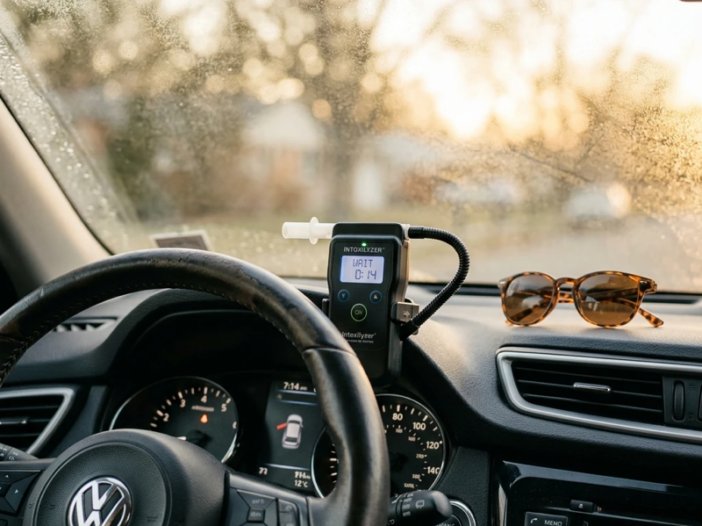
High BAC Interlock Requirements: What Happens at 0.15+ BAC
A BAC interlock requirement hits harder when you blew a 0.15 or
above. You’re not in the same legal bucket as someone who just crossed
the 0.08 line. The penalties are stiffer, the monitoring runs longer,
and the path back to a normal license has more steps along the way.
This guide walks through what changes at 0.15+. You’ll see how
enhanced DUI penalties stack up, why your interlock measures breath
alcohol instead of blood alcohol, what actually triggers a failed test,
and how long the device is likely to stay in your car. The
state-by-state comparison table near the bottom is the part most people
end up screenshotting.
What an
Ignition Interlock Device Actually Does
An ignition interlock device (IID) is a small breath tester wired
into your car’s starter circuit. You blow into it before turning the
key. If your breath reads above a preset limit, the engine won’t start.
That’s it.
Most states set that fail threshold somewhere between 0.02 and 0.025
BrAC (breath alcohol concentration). That’s well below the 0.08 legal
driving limit. The reasoning is simple: if a judge ordered you to drive
sober, the state wants real-time proof you actually are.
Who Gets Ordered to Install
One?
Not every DUI conviction triggers an interlock order, but the picture
changes fast once your BAC climbs. Per the Insurance Institute
for Highway Safety’s state-by-state alcohol interlock laws, a
majority of states now require an IID for all first-time
impaired-driving offenders, while a smaller group, including states like
Georgia, only mandate the device for first offenders whose BAC reaches
0.15 or higher.
Repeat offenders face an IID almost everywhere, regardless of BAC.
But if you’re a first-timer who blew high, the law tends to treat you
more like a repeat offender. Longer suspension. Mandatory interlock.
More boxes to check before you can drive freely again.
When 0.15+ Triggers a
Mandatory Interlock
Most states treat 0.15 BAC as an aggravating factor that upgrades
nearly every consequence in the DUI penalty stack. A standard first DUI
might mean a 90-day suspension and an optional IID. A high-BAC first
offense often means 12 to 24 months of mandatory interlock, plus longer
license loss and bigger fines.
The exact threshold isn’t identical everywhere. The most common
cutoff is 0.15, but a few states draw the line at 0.16 or 0.17, and some
reserve their toughest tier for 0.20+. The principle holds across all of
them: the higher you blew, the longer the state plans to watch you
drive.
High-BAC DUI
Penalties Beyond the Interlock
The IID is one piece. A high-BAC conviction typically stacks extra
penalties on top of the standard DUI menu:
- Longer license suspensions, sometimes double the standard
period - Higher fines and court costs
- Mandatory alcohol education or treatment programs
- Minimum jail time in some states (often two to ten days) that
doesn’t apply to lower-BAC first offenses - An SR-22 insurance filing for two to three years after
reinstatement
For the bigger picture by jurisdiction, state DUI
laws lay out what each state’s penalty structure looks like in plain
language. High-BAC drivers consistently land in the harshest tier
wherever they’re convicted.
BAC
vs. BrAC: Why Your Interlock Number Looks Different
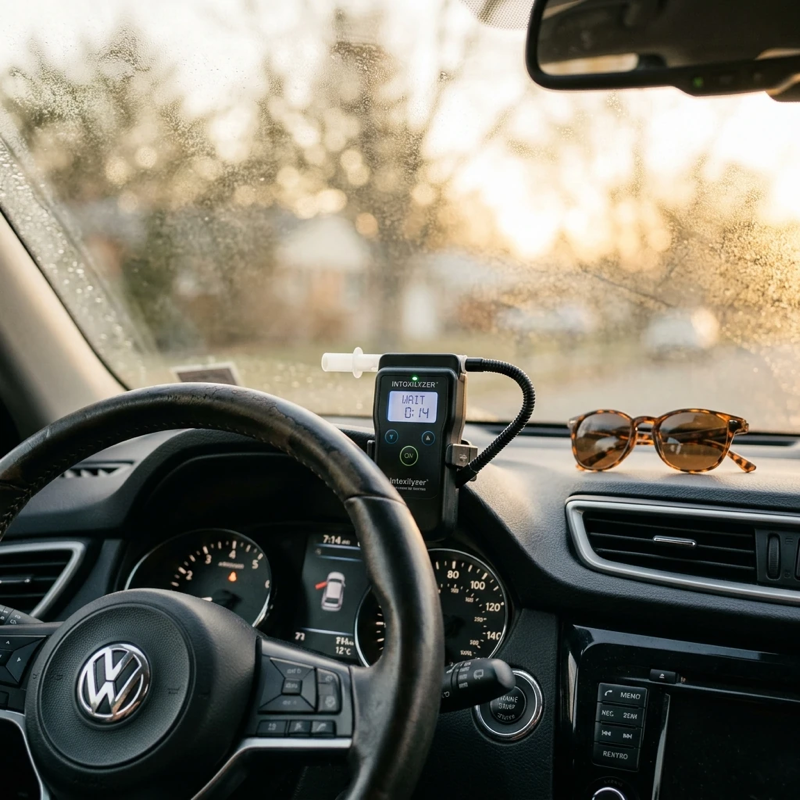
This part trips people up. Your arrest paperwork shows a blood
alcohol concentration (BAC) reading. Your interlock measures breath
alcohol concentration (BrAC). They’re related, but they aren’t the same
number.
BrAC estimates blood alcohol through a breath sample, and the
conversion isn’t always exact. Body temperature, breathing pattern, even
altitude can nudge the reading slightly. That’s a big reason the IID
fail threshold sits so low at 0.02–0.025. It bakes in some margin while
still catching any meaningful alcohol use. If you want a deeper
explanation, the post on blood
alcohol vs. breath alcohol walks through the science without getting
nerdy about it.
Residual mouth alcohol from mouthwash, cough syrup, or even certain
foods can also push a reading up briefly. The device typically allows a
retest after a short waiting window once the residue clears.
At What BAC Will You
Fail Your Interlock?
Three different thresholds matter here, and they get confused all the
time:
- 0.02–0.025 BrAC: typical interlock fail threshold
(varies by state) - 0.08 BAC: the standard legal driving limit
nationwide - 0.15+ BAC: the “high BAC” tier that triggers
enhanced penalties in most states
Failing your IID is not the same thing as being legally drunk. You
can fail a startup test at 0.03 after one beer at lunch, and the car
simply won’t start. That’s still a recorded event your monitoring
authority sees.
Lockouts,
Rolling Retests, and What Gets Reported
Fail a startup test and you’ll typically get a short lockout, usually
a few minutes, before you can try again. The device logs every attempt
either way.
Rolling retests add another layer. While you’re driving, the device
randomly asks you to blow again. Miss it or fail it, and that’s a logged
violation. Stack up enough violations and you may face an extended IID
term, a probation hearing, or a license revocation. Different states
define “violation” differently, so it’s worth understanding what
happens if you fail your interlock test under your specific state’s
rules before it ever comes up.
If a rolling retest does come at the worst possible moment, like in
heavy traffic, the device gives you a few minutes to safely pull over
and blow. You don’t have to take a sip of coffee one-handed at 70
mph.
How
Long the Interlock Stays in Your Car After a High-BAC DUI
Standard first-offense IID terms often run six to twelve months.
High-BAC first offenders typically face 12 to 24 months, and some states
stretch that further for 0.20+ readings or a refusal to test at the
scene.
Here’s a detail that catches people off guard. The clock doesn’t
always start when you think. Some states begin counting from the
conviction date. Others start counting from your installation date. So
if you wait six weeks to get the device installed, that’s six weeks
tacked onto the end of your restricted-driving period in those states.
For state-specific timing, the post on how
long you need an ignition interlock gives a useful jumping-off
point, and your state DMV or attorney can confirm the exact rule.
Compliance-Based
Removal: Why a Clean Record Matters Late in the Term
Time served alone isn’t always enough. A growing number of states use
compliance-based removal (CBR) laws. Translation: you can’t just wait
out the clock. You also have to log a clean stretch at the end, often
three to six consecutive months without a fail, a missed calibration, or
a tamper alert.
For high-BAC drivers, this matters more because the monitoring period
is already longer, so there are simply more chances to trip something. A
failed rolling retest in month 11 of a 12-month term could push your
removal date out by 90 days or more. The way to handle it is boring but
effective: never blow into the device after drinking, never miss a
calibration appointment, and call support the moment something on the
device looks off.
If something does go wrong on a test, the post on how
to avoid an interlock device violation covers the most common
slip-ups and how to keep them off your record.
State-by-State
High BAC Interlock Requirement Overview
Penalty structures vary, but the general pattern below holds in most
states with enhanced-BAC laws. Use this as a starting framework, then
verify your exact state’s rules with the DMV or your attorney.
| BAC Tier (First Offense) | Typical IID Requirement | Typical IID Duration | Common Add-On Penalties |
|---|---|---|---|
| 0.08–0.14 | Optional or state-dependent | 6–12 months if required | Standard DUI fines, 30–90 day license suspension |
| 0.15–0.19 (“high BAC”) | Mandatory in most states | 12–18 months | Longer suspension, larger fines, alcohol program |
| 0.20+ (“extreme” or “aggravated”) | Mandatory, often with extra conditions | 18–24+ months | Possible minimum jail time, ignition interlock with camera, SR-22 |
| Test refusal | Mandatory in implied-consent states | 12–24 months | Automatic license suspension separate from DUI outcome |
A few state-specific anchors worth knowing:
- Arizona: “Extreme DUI” applies at 0.15+ and “Super
Extreme” at 0.20+, each tier carrying mandatory jail and longer IID
terms. - California: A first-offense DUI with a BAC of 0.15+
is treated as an enhancement that can extend the IID requirement and
probation period. - Florida: First-offense IID is generally required
when BAC is 0.15+, or when a minor is in the vehicle at the time of
arrest. - Pennsylvania: Uses a tiered system where 0.10–0.159
is the “high rate” tier and 0.16+ is the “highest rate” tier, each with
mandatory interlock for one year on a first offense. - Texas: A first DUI with a BAC of 0.15+ is a Class A
misdemeanor instead of Class B, with mandatory IID on license
reinstatement.
The CDC reports that ignition interlocks are linked to roughly a 70%
reduction in repeat drunk-driving offenses while the device is
installed, and a study from the
Governors Highway Safety Association found that compliance-based
removal laws further cut repeat offenses among interlock users. Those
numbers are part of why states keep tightening the rules at 0.15+.
Frequently Asked Questions
What’s a “high BAC” DUI?

Most states define high BAC as a blood alcohol concentration of 0.15
or higher at the time of arrest, though a few use 0.16 or 0.17 as the
cutoff and reserve a separate “extreme” tier for 0.20+. The label
matters because it triggers enhanced penalties: longer license
suspension, bigger fines, possible jail time, and a mandatory ignition
interlock on a first offense in most states. Your charging document will
say whether the high-BAC enhancement applies in your case.
How
long does a high BAC interlock requirement usually last?
Most high-BAC first-offense IID terms run 12 to 18 months, with some
states pushing it to 24 months or longer for readings of 0.20 and above.
Standard first DUIs without the high-BAC enhancement are often six to
twelve months. Several states also use compliance-based removal, which
means you have to log a clean stretch (often three to six months) at the
end before the device can come out, regardless of total time served.
Will the
interlock fail me even if I’m under 0.08?
Yes. Interlocks are calibrated to fail at roughly 0.02 to 0.025 BrAC,
which is far below the 0.08 legal driving limit. That’s intentional. If
a court ordered you to drive sober, the device is checking for any
alcohol, not just enough to be charged with DUI. One drink at lunch can
be enough to lock you out, and the attempt is logged either way.
Can mouthwash or
food trigger a false reading?
It can, briefly. Mouthwash, cough syrup, breath sprays, and certain
fermented foods can leave alcohol residue in your mouth for 15 to 20
minutes after use. Most devices give a short waiting window and let you
retest. The post on foods
and items that can trigger a BrAC reading covers the common culprits
and how to avoid them before a test.
What’s the difference
between BAC and BrAC?
BAC is your blood alcohol concentration, measured in a blood draw or
estimated by a calibrated breathalyzer at the police station. BrAC is
breath alcohol concentration, what your interlock device reads from a
breath sample. They’re closely related but not identical, because the
breath-to-blood conversion ratio varies slightly with body chemistry.
Your court paperwork uses BAC. Your daily interlock readings will be
reported in BrAC.
Can
I drive someone else’s car with my interlock requirement?
Generally, no. In most states, you can only drive vehicles equipped
with an approved IID, even if the car belongs to a spouse, friend, or
employer. Some states offer a limited employer exemption for company
vehicles driven during work hours, but those exemptions require
paperwork filed with the monitoring authority. Driving an uninstalled
vehicle while under an IID order is a separate violation that can extend
your term or revoke your license.
How long does
interlock installation take?
Installation usually takes about a couple of hours, including the
device wiring, a calibration test, and a hands-on walkthrough of startup
tests and rolling retests. You’ll typically leave the appointment
knowing how to use the device. If you want to plan around it, you can schedule
install at a service center near you and get a sense of the
appointment window in advance.
What
happens if my car battery dies while I have an interlock?
A dead battery, jump start, or extended disconnection can sometimes
log as a power interruption, which some states treat as a possible
tamper event. Before disconnecting the battery or taking the car in for
service, call your interlock provider for the compliant process. Keep
your repair receipts. If your monitoring authority asks, you’ll have
documentation showing the disconnect was for legitimate maintenance, not
an attempt to circumvent the device.
Will I need
SR-22 insurance with a high-BAC DUI?
In most states, yes. SR-22 is a certificate filed by your insurer
with the state confirming you carry the minimum liability coverage
required after a DUI. It’s not a separate policy; it’s a filing attached
to your existing one. Expect to carry SR-22 for two to three years after
license reinstatement. Insurance premiums almost always rise, sometimes
significantly, after a high-BAC conviction.
Can the interlock
requirement be shortened?
Sometimes. A handful of states allow early removal for drivers who
maintain a long violation-free record, complete required treatment, and
apply through the proper channel. More commonly, the requirement stays
the full statutory length, and the only way to shorten it is to qualify
for an ignition
interlock exemption under a narrow set of circumstances. Talk to
your attorney about whether your state allows reduction motions.
Your Next Step After a
High-BAC Charge
A BAC interlock requirement at 0.15 or above isn’t a minor
inconvenience. It’s a longer commitment with higher stakes and less room
to make small mistakes. The faster you understand your state’s rules,
install your device, and start your compliance clock, the sooner you get
to an unrestricted license again.
Choosing the right provider matters over a 12-to-24-month program.
Low Cost Interlock installs state-approved devices in 40+ states, with
transparent ignition
interlock pricing, no hidden fees, and a Price Match Guarantee. If a
competitor quotes you a lower price, call (844)
387-0326, and we’ll beat it or refund the difference. Get your
60-second quote and start your compliance clock today.
This article is general information, not legal advice. Consult an
attorney about your specific case.