
The Science of False Positives in Failed Breathalyzer Tests
The Science of False Positives: How to Challenge a Failed Breathalyzer Test is about understanding that a number on a screen is not the whole story. Breath-testing devices estimate alcohol based on chemical reactions and assumptions about your body, and those assumptions are not perfect for every person or every situation. Under certain conditions, they can overstate how much alcohol is actually in your system.
Learning how these devices work, what commonly goes wrong, and how results are used in court can help you make informed decisions after a DUI arrest. This guide walks through the science behind breath tests, the major categories of false positives, and practical ways that science can be used to question a failed result and plan your next steps.
The Science of False Positives: How to Challenge a Failed Breathalyzer Test From the Ground Up
To understand false positives, you first need a basic picture of what a breathalyzer is actually measuring. The device is not directly analyzing how much alcohol is in your blood. Instead, it measures alcohol in your breath and then uses a conversion factor to estimate blood alcohol concentration, or BAC.
How Breathalyzers Measure Alcohol in Your Breath
When you drink, alcohol is absorbed through your stomach and intestines into your bloodstream and carried throughout your body, including your lungs. In the tiny air sacs of the lungs, called alveoli, alcohol moves from the blood into the air you exhale. Breathalyzers are designed to capture this “deep lung” or alveolar air.
The device then applies a standard ratio to translate breath alcohol into an estimated BAC. Many breath-testing systems assume that the alcohol concentration in deep-lung air is 1/2100 of the concentration in the blood. That is called the partition ratio. The catch is that this ratio actually varies from person to person and even from moment to moment, which is one scientific reason readings can be slightly off.
Most police-used handheld devices rely on a fuel-cell sensor. Alcohol in your breath reacts on the sensor’s surface and produces an electrical current. The stronger the current, the higher the estimated breath alcohol concentration (BrAC). Larger, stationary machines at a police station or jail often use infrared spectroscopy, or a combination of infrared and fuel-cell technology, to detect alcohol molecules by how they absorb light.
Another scientific wrinkle is timing. After your last drink, your BAC usually rises for a period, levels off, and then slowly falls as your body metabolizes alcohol. A breath test taken while your BAC is still climbing might show a different number than a test taken while it is falling, even if your actual impairment at the time of driving was different than at the time of testing.
Device Types, Accuracy Limits, and Built-In Error Margins
Not every breath test is treated the same way in court. A roadside handheld test is often a preliminary breath test (PBT) used to help an officer decide whether to arrest you. The test you take later at a station on a larger, more sophisticated machine is usually an evidentiary breath test, which is the one more likely to be presented in court as proof of your BAC.
Even with advanced engineering, no breath-testing technology is perfect. A Federal Register notice from the National Highway Traffic Safety Administration proposed that future in-vehicle alcohol sensors should have no more than a 0.5% chance of a false positive and a measurement tolerance of plus or minus 0.005 g/dL BAC. Those are stringent requirements, yet they still recognize that some level of error is unavoidable.
Real-world police instruments must also be regularly calibrated and maintained to stay within their expected accuracy range. Over time, sensors can drift, environmental conditions can interfere with readings, and internal components can wear out. That is why many states require agencies to keep detailed calibration records, run periodic control tests, and verify that operators are properly trained.
From a defense perspective, these scientific and procedural safeguards are not just technicalities. They are the backbone of any argument that a specific breath result should not be trusted in your case because the device, the environment, or the operator did not live up to those standards.
Real-World Causes of Breathalyzer False Positives
The Science of False Positives: How to Challenge a Failed Breathalyzer Test becomes much clearer when you look at specific things that can push a reading higher than it should be. These fall into a few broad categories: physiological conditions, everyday products and environments, and device or procedural problems.
Physiological and Medical Triggers
Some false positives are linked to how your body works rather than to the machine itself. People with certain medical conditions may have more alcohol or alcohol-like substances in their mouths or breath that do not reflect their true blood alcohol level.
Gastroesophageal reflux disease (GERD), heartburn, or a hiatal hernia can cause stomach contents, including alcohol, to flow back up into the esophagus and mouth. If that happens near the time of your breath test, the device may sample this concentrated “mouth alcohol” rather than the deeper lung air it is designed to measure, giving an inflated result.
Diabetes and ketogenic or very low-carb diets can also complicate things. When your body burns fat for energy, it can produce ketones like acetone. Some of those ketones can be exhaled and, in certain circumstances, converted into chemicals that a fuel-cell sensor interprets as alcohol. That means a person in ketosis may register a higher BrAC even if they have consumed little or no alcohol.
Breathing patterns and body temperature can further influence readings. Hyperventilating, holding your breath, or taking very shallow breaths just before blowing into the device can slightly alter the concentration of alcohol in the breath sample. Fever or a significantly elevated body temperature can change how quickly alcohol moves from blood to breath, potentially nudging a reading upward.
Everyday Products and Environmental Alcohol
Many common products contain alcohol or solvents that can cling to your mouth or be present in the surrounding air. If a breath test is given too soon after using them, the device might capture those vapors instead of, or in addition to, deep-lung air.
Alcohol-based mouthwash, breath sprays, and some dental products are classic examples. If you rinse and then blow into a device within a few minutes, the remaining liquid in your mouth can produce a very high reading even if your actual BAC is low. Similarly, some fermented foods and drinks, like kombucha, can leave short-lived alcohol vapor in the mouth.
Environmental exposure also matters. Police officers often use alcohol-based hand sanitizers and may work around cleaning agents, fuel, or paint fumes. In poorly ventilated areas, high levels of these vapors can interfere with the sensor. While this is less common, it is another path to a misleading result when combined with other issues.
Device Problems and Procedural Mistakes
Even if your body and environment are not unusual, the way the machine is maintained and the way the test is administered can create false positives. Breathalyzers must be calibrated on a regular schedule using reference solutions or gas mixtures, and those calibrations need to be documented and traceable.
If a device is overdue for calibration, has failed recent control checks, or has been subjected to temperature extremes, shock, or contamination, its readings may drift. Sensors can also be affected by accumulated residue inside the device, which is why cleaning and maintenance protocols are important.
Procedural rules exist to limit these risks. Officers are typically trained to watch a person for a set “observation period,” often 15–20 minutes, before giving an evidentiary breath test. During that time, the subject is supposed to avoid eating, drinking, vomiting, belching, or putting anything in their mouth. Skipping or shortening this observation period makes it more likely that mouth alcohol or recent exposure will skew the result.
Improper instructions can matter too. If you are not told to take a deep breath, seal your lips completely, and blow steadily for the required time, the machine might not capture a consistent sample from deep in your lungs. Incomplete or erratic breaths can trigger errors or inconsistent readings that should be documented but sometimes are not fully explained in reports.
The table below links several frequent false-positive causes to the types of evidence a defense team might look for.
| False-positive source | How it can inflate a reading | Helpful evidence to investigate |
| GERD or chronic acid reflux | Brings alcohol-rich stomach contents into the mouth, creating mouth alcohol instead of pure deep-lung air. | Medical records, prescription lists, prior diagnoses, and any notes about heartburn or regurgitation during the stop. |
| Diabetes or ketogenic diet | Produces ketones and related compounds that some sensors can misinterpret as alcohol. | Doctor’s records, lab work, diet logs, and pharmacy printouts confirming diabetes treatment or strict low-carb dieting. |
| Recent use of mouthwash or breath spray | Leaves concentrated, short-lived alcohol in the mouth that spikes a breath sample. | Receipts, bathroom or vehicle items, and testimony about last use relative to the time of testing. |
| Vomiting, burping, or regurgitation | Brings alcohol from the stomach into the mouth right before the test. | Officer reports, videos, jail logs, and witness statements documenting any such episodes. |
| Solvent or chemical exposure | Introduces interfering vapors that the sensor may register as alcohol. | Work records, incident descriptions, and details about recent painting, fueling, or chemical use near the test site. |
| Poor calibration or maintenance | Allows the device to drift out of its acceptable accuracy range. | Calibration logs, maintenance records, control-test results, and manufacturer guidelines. |
| Observation-period violations | Increases the chance that mouth alcohol or contamination remains at test time. | Bodycam or station video, dispatch logs, and discrepancies in officers’ time notes. |
Step-by-Step Guide to Challenging a Failed Breathalyzer Test
A failed breath test does not automatically equal a conviction, but ignoring it or hoping it goes away usually makes things worse. Courts treat breathalyzer results seriously, especially when they come from approved evidentiary machines. This section is not legal advice, but it outlines common steps people take with their attorneys to examine the test and decide how to respond.
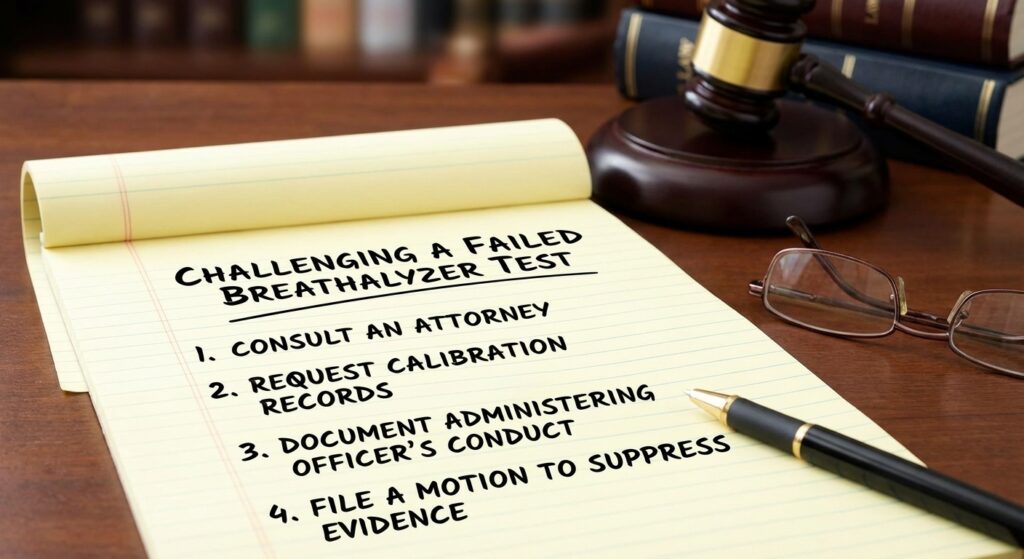
Deadlines can arrive fast. Many states give you only a short window to request a hearing to challenge an administrative license suspension, and it can take time to gather technical records. Acting promptly and staying organized can make a significant difference in how effectively you can use The Science of False Positives: How to Challenge a Failed Breathalyzer Test in your favor.
Critical Steps Right After a Failed Breath Test
Right after an arrest, people often feel shocked, embarrassed, or angry, which makes it hard to think clearly. Once you are safe and no longer in police custody, your focus should shift to preserving details while they are still fresh in your mind.
Avoid discussing specifics of the incident on social media or with anyone other than your lawyer. Instead, concentrate on privately collecting information that might later explain an unusual breath result or expose procedural errors.
- Write out a detailed timeline. Note when you started and stopped drinking, what you drank, when you were stopped, and when each breath test occurred. Include meal times, as food can affect absorption.
- List all medications and supplements. Include prescription drugs, over-the-counter medicines, inhalers, and herbal products, along with when you last took each one.
- Document health conditions. Record any history of GERD, ulcers, diabetes, hypoglycemia, asthma, or other conditions that could affect breathing or metabolism.
- Note products used near the time of arrest. Mouthwash, breath mints, cough syrup, vaping products, or energy drinks can all be relevant details.
- Describe the environment. Include any strong chemical smells, recent painting or gluing, refueling, or use of cleaning agents in the car or testing area.
- Detail officer instructions and behavior. Were you told to wait before blowing? Did you burp, cough, or vomit? Did the officer restart the observation period if that happened?
- Identify potential witnesses. Friends, servers, bartenders, rideshare drivers, or family members may be able to confirm how much you drank or how you appeared.
- Save physical and digital records. Keep receipts, bar tabs, credit card statements, text messages, and rideshare logs that shed light on your movements and consumption.
Share this information only with your attorney so it is protected as much as possible. The more specific and factual your notes, the easier it is for a defense team to match them against official records and identify inconsistencies.
Gathering Records, Data, and Scientific Evidence
Challenging a breath test usually requires more than your word against the officer’s. Your lawyer can often request discovery, which is the process of obtaining the government’s evidence. For breathalyzer cases, that evidence goes far beyond a single number on a printout.
Depending on your jurisdiction and the type of device used, important materials can include:
- Calibration logs showing when the machine was last adjusted and whether it passed control tests.
- Maintenance and repair records revealing any recurring problems or recent service.
- Operator training and certification documents for the officers who administered the test.
- Copies of the breath-test printouts, including any error messages or aborted attempts.
- Body-worn camera or dashcam video that captures field sobriety tests, the stop, and parts of the observation period.
- Jail or station surveillance footage of the breath test itself, when available.
- Dispatch logs and reports that help verify times, locations, and officer movements.
- Medical records, pharmacy histories, or lab tests that support physiological explanations for unusual readings.
Forensic laboratories and agencies are under growing pressure to standardize how they manage this kind of evidence. A NIST OSAC standards document on forensic toxicology quality systems reported that early-adopting state labs saw a 25% drop in breath-test result suppressions once they implemented stricter calibration checks, uncertainty estimates, and staff competency audits.
From a defense standpoint, those standards essentially set a benchmark. If your jurisdiction follows similar practices, your attorney will look for gaps between what should have been done and what the records actually show. If your jurisdiction has looser practices, that contrast itself can be used to argue that the local system is more vulnerable to error.
In some situations, it may be possible to gather independent evidence about your alcohol level, such as a hospital blood test taken around the time of arrest or readings from a personal breath device. Timing is crucial, and not every case allows for this, but additional data points can help put a single disputed result in context.
Researchers are also exploring smarter testing protocols to reduce false positives without changing hardware. A NIST News article described a cannabis breath-testing approach that collects a second sample about an hour after the first and compares how THC levels decline. In simulations, that simple timing change cut false-positive cannabis DUI indications by roughly one-third and correctly identified recent use in about 85% of cases, showing how additional samples and time-based analysis can sharpen impairment assessments.
Using The Science of False Positives: How to Challenge a Failed Breathalyzer Test in Your Defense Strategy
Once technical records and background information are in hand, your attorney can translate scientific issues into legal arguments. Courts generally require that breath-test evidence be both relevant and reliable, which often means showing that the machine was working properly, that procedures were followed, and that the result is tied to your condition at the time of driving rather than just at the time of testing.
Prosecutors receive detailed training on these topics. A 2025 National District Attorneys Association monograph on breath testing compiles research on device calibration, observation periods, and mouth-alcohol contamination, and it has been adopted in training programs across dozens of states. Because the manual also highlights common vulnerabilities, defense lawyers can treat it like a roadmap for cross-examining officers on whether they followed their own side’s best practices.
It also matters whether the state is relying on a preliminary roadside test or a formal evidentiary test. Although rules vary, preliminary results are often limited to establishing probable cause, while evidentiary results are used to prove a per se BAC offense or support an “impairment” charge. The comparison below outlines typical differences.
| Feature | Preliminary roadside breath test (PBT) | Evidentiary breath test |
| Typical location | Roadside during the traffic stop. | Police station, jail, or dedicated testing facility. |
| Primary purpose | Help officer decide whether to arrest or continue investigation. | Provide admissible evidence of BAC for court and DMV hearings. |
| Device type | Portable handheld unit, usually fuel-cell only. | Larger machine, often with more advanced or dual sensor technology. |
| Admissibility limits | Sometimes limited or excluded for proving BAC; may be used for probable cause. | Generally admissible if foundation requirements (calibration, training, procedures) are met. |
| Common defense focus | Environmental contamination, operator error, and limited legal purpose. | Calibration and maintenance gaps, observation-period violations, and medical or mouth-alcohol issues. |
Armed with this information, a defense team might file motions to suppress or limit breath-test evidence, arguing that legal prerequisites were not met. Even if the judge allows the results, highlighting weaknesses can still influence plea negotiations or how a jury views the state’s case, especially when the reported BAC is close to the legal limit or when there is credible evidence of a medical or environmental factor.
Once your case is resolved, you may still have to deal with license restrictions and ignition interlock requirements. Working with a science-focused, transparent ignition interlock provider can reduce stress during that phase. A state-approved ignition interlock device provider such as Low Cost Interlock uses calibrated fuel-cell technology and documented service procedures to help ensure readings are reliable while you are trying to rebuild your driving record.
Frequently Asked Questions
What should I ask a DUI attorney to make sure they understand breath-test science?
Ask how often they challenge breath-test evidence, which specific device models they’ve handled, and whether they work with independent toxicology experts. Request examples of past cases where scientific arguments affected the outcome, and clarify how they plan to investigate the technical details in your situation.
How does a blood test compare to a breathalyzer in a DUI case?
Blood tests directly measure alcohol in a blood sample, while breathalyzers estimate it from exhaled air. Blood results often carry more weight in court but also come with their own procedural requirements, such as proper collection, storage, and lab analysis, which can be scrutinized for errors.
Can refusing a roadside or evidentiary breath test help my case?
Refusal can sometimes limit the evidence against you, but many states impose automatic license penalties and allow prosecutors to argue that refusal shows consciousness of guilt. The impact is highly state-specific, so it is a strategic decision that should be made with legal advice whenever possible.
How long after drinking can alcohol still show up on a breath test?
Alcohol can be detectable on a breath test for several hours, depending on how much you drank, your body size, metabolism, and food intake. Even after you feel more sober, your estimated alcohol level may remain above legal limits for longer than you expect.
Are personal breathalyzers useful if I want to avoid future DUI issues?
Quality personal devices can give you a rough sense of your alcohol level and help you make more cautious decisions about driving. They should not be treated as legal-grade instruments, so it is wise to build in a safety margin and plan transportation that does not depend on a borderline reading.
How can a DUI and failed breath test affect my job and professional licenses?
Certain professions, especially those involving driving, safety-sensitive work, or state-issued licenses, may require you to report a DUI or face disciplinary review. Understanding these collateral consequences early allows you and your attorney to tailor your defense and mitigation strategy to protect your career where possible.
What happens if I get a DUI and ignition interlock requirement in a different state from where I live?
Interstate driver’s license compacts often allow states to share DUI and interlock information, so an order in one state can affect your license in another. You may need an interlock provider that operates in multiple jurisdictions and guidance from local counsel to keep both states satisfied with your compliance.
Moving Forward After a Failed Breath Test: Safer Driving and Interlock Options
Even if you successfully challenge a breath test in court, or negotiate a reduced charge, you may still face license restrictions or a requirement to install an ignition interlock device (IID). Understanding how IIDs work and how they differ from roadside breathalyzers can help you stay compliant, avoid new problems, and begin restoring your independence.
An IID is installed in your vehicle’s ignition system and requires you to blow into a handheld unit before the car will start. Many programs also require rolling retests while you drive. The device measures your BrAC and compares it to a preset limit; if the sample is above that limit, the car will not start or you will be prompted to pull over safely. All of this is recorded and reported to the monitoring authority.
Public safety data underscores why these programs exist. According to Insurance Institute for Highway Safety research, states that require ignition interlocks for all convicted DUI offenders have seen about a 16% reduction in fatal crashes involving alcohol-impaired drivers, and equipping every new passenger vehicle with passive alcohol-detection technology could prevent an estimated 9,400 deaths per year in the United States. Those numbers show both the preventive power of interlocks and the importance of accurate, well-managed alcohol-sensing systems.
Accuracy matters for you personally as well. A reliable IID minimizes the risk that non-alcohol factors will trigger lockouts or false violations. Modern devices use fuel-cell sensors similar to evidentiary machines and are calibrated to state-specific BrAC limits, which helps distinguish genuine alcohol use from minor fluctuations or contaminants when the system is maintained correctly.
Low Cost Interlock focuses on making that compliance phase as simple and predictable as possible. Its flagship LCI-777 ignition interlock device uses a fuel-cell sensor calibrated to your state’s BrAC limit and is designed around a quick three-second exhale, with a compact handset often referred to as “The Can.” A companion mobile app supports remote warm-ups so the device is ready when you reach your car, and single-use mouthpieces promote better hygiene and discretion.
For many drivers, cost and hidden fees are major worries after a DUI. Low Cost Interlock emphasizes affordability through bi-weekly payments, free shipping on devices, and routine calibrations priced at about $20, while promising no hidden fees and no penalty fees for failed tests. That transparency can make it easier to budget for an ignition interlock requirement that may last months or years.
- Straightforward installation and setup. An experienced ignition interlock installation and support team coordinates appointments and walks you through how to use the device from day one.
- Ongoing calibration and compliance support. Automated SMS and email reminders help you stay on top of calibration dates so you do not miss a required service.
- Discreet, user-friendly hardware. Silent operation, a compact handset, and single-use mouthpieces reduce embarrassment and make daily use less stressful.
- Accessible customer service. Bilingual support staff help answer questions about device operation, reporting, and what to expect from your ignition interlock program.
- Options for individuals and fleets. In addition to individual drivers, Low Cost Interlock supports employers who need fleet vehicles to comply with exemption or monitoring programs in multiple states.
Ultimately, The Science of False Positives: How to Challenge a Failed Breathalyzer Test is about more than winning a legal argument. It is about making sure that decisions affecting your license, livelihood, and reputation are based on accurate, well-documented science rather than unquestioned assumptions or rushed procedures. That starts with understanding how breath testing works, continues with a careful review of your specific test, and extends into how you manage any ignition interlock requirements that follow.
By pairing a knowledgeable DUI attorney who understands breath-test science with a dependable, state-approved interlock provider like Low Cost Interlock, you can address both sides of the problem: challenging questionable evidence from the past and preventing new issues as you move forward. If you are facing an ignition interlock requirement after a failed breath test, call 844-218-5398 or visit Low Cost Interlock to explore an affordable ignition interlock program that helps you regain control and get back on the road with confidence.