
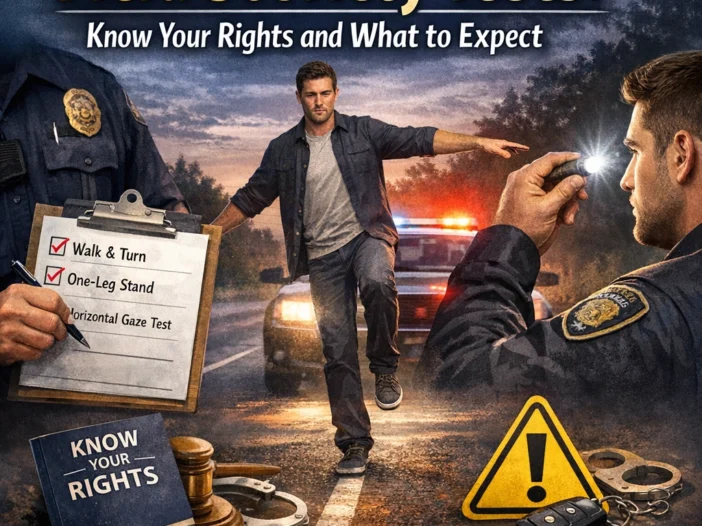
Field Sobriety Tests and Your Rights at DUI Stops
Field sobriety tests are one of the most stressful parts of a DUI stop, especially when you are unsure of your rights. Officers use these roadside exercises to decide whether they believe you are impaired enough to be arrested, which means what happens in a few minutes on the shoulder can impact your license, your job, and even your criminal record.
Understanding how these tests work, what officers are actually looking for, and when you can say no gives you back some control in a situation that often feels one-sided. This guide walks through the full DUI stop sequence, explains each type of test in plain language, outlines your basic rights, and shows what to expect if you fail or refuse.
Field sobriety tests in a DUI stop: what really happens roadside
During a typical DUI investigation, field sobriety tests appear in the middle of the encounter, not at the beginning or the end. First, an officer notices driving behavior they view as suspicious, such as drifting between lanes, braking erratically, or reacting slowly to traffic signals.
Once the emergency lights activate, you are expected to pull over safely, ideally to the right shoulder or a nearby parking lot. After approaching your window, the officer will usually ask for license, registration, and proof of insurance while observing your movements, speech, and any odors or open containers inside the vehicle.
If the officer believes there may be alcohol or drug involvement, they often ask you to step out of the car. At that point they may move you to a safer, better-lit area and begin field sobriety tests. These tasks are designed as “divided attention” challenges that require you to balance, follow instructions, and concentrate at the same time.
Officers typically note every observation in their report, including how you exit the vehicle, whether you use the car for support, and how well you follow instructions before the tests begin. Those observations, combined with your performance on the exercises, become the basis for deciding whether they have probable cause to arrest you and request formal breath or blood testing.
At sobriety checkpoints, the sequence is similar but more compressed. Officers stop many cars in a row, ask brief screening questions, and then direct selected drivers to a secondary area for further evaluation, which is where field sobriety tests may be requested.
The three standardized field sobriety tests officers rely on
Across the United States, most officers are trained to use three specific “Standardized Field Sobriety Tests” (often called SFSTs). These tests were developed and validated through federal research so that, when properly administered, they follow the same pattern in every jurisdiction.
The three SFSTs are the Horizontal Gaze Nystagmus eye test, the Walk-and-Turn test, and the One-Leg Stand test. Together, they are meant to assess balance, coordination, ability to follow multi-step instructions, and eye movements that may indicate alcohol influence.
Horizontal Gaze Nystagmus (HGN) eye test
In the HGN test, the officer asks you to follow a stimulus such as a pen tip or small light with your eyes only, without moving your head. They move the object slowly from side to side and watch your eye movements closely.
The officer is checking for an involuntary jerking of the eyes, called nystagmus, which can become more noticeable with alcohol consumption. They also look for whether your eyes can track smoothly and how far to the side they move before the jerking appears.
Because eye conditions, certain medications, and even fatigue can affect eye movements, the way the officer performs and records this test can become a major issue later if the case is challenged.
Walk-and-Turn field sobriety test (WAT)
For the Walk-and-Turn test, the officer usually asks you to stand in a heel-to-toe position on a real or imaginary line while they give detailed instructions. You must listen without moving until they tell you to begin.
When the test starts, you are told to take a specific number of heel-to-toe steps down the line, pivot using small steps, and then return the same way. As you perform the task, the officer watches for balance problems, missed heel-to-toe contact, stepping off the line, starting too soon, or failing to follow the directions exactly.
This test can be especially challenging on uneven pavement, in poor weather, or for people with back, leg, or inner-ear problems that already affect balance and coordination.
One-Leg Stand balance test
In the One-Leg Stand, you are asked to stand with your feet together, then raise one foot a short distance off the ground while keeping your arms at your sides. Often you are instructed to count in a steady rhythm until told to stop.
The officer notes whether you sway, put your foot down, hop, or use your arms for balance. Even small movements can be recorded as “clues” of possible impairment within their scoring system.
Age, weight, footwear, and pre-existing injuries can all make this test significantly harder, especially on cold or sloped pavement.
| Standardized test | Main skill evaluated | Typical officer instructions | Common “clues” officers record |
| Horizontal Gaze Nystagmus (HGN) | Eye tracking and involuntary eye movements | Follow a pen or light side to side with eyes only | Jerking eye movements, inability to track smoothly, early onset of nystagmus |
| Walk-and-Turn (WAT) | Balance plus divided attention to steps and instructions | Stand heel-to-toe, take a set number of steps down and back on a line | Stepping off line, missing heel-to-toe, using arms for balance, wrong number of steps |
| One-Leg Stand (OLS) | Static balance and sustained concentration | Lift one foot off ground and count steadily until told to stop | Swaying, hopping, putting foot down early, raising arms from sides |
Officers do not simply invent these procedures on the spot. They are trained using national curricula, and many agencies now require periodic refreshers. For example, the National Highway Traffic Safety Administration SFST Refresher Manual describes a 2024–2025 program that reinforces step-by-step protocols for all three standardized tests, which has been associated with fewer wrongful DUI arrests when followed correctly.
Non-standard roadside exercises and how officers use them
Not every test you might be asked to perform is part of the standardized trio. Many officers add extra “non-standardized” exercises that are not formally validated but still end up in police reports and courtroom testimony.
These alternative field sobriety tests vary widely from one officer or region to another, and they tend to be more subjective. Common examples include:
- Reciting part of the alphabet without singing
- Counting numbers backward from a chosen starting point
- Touching the tip of your nose with your finger while your eyes are closed
- Standing with feet together and estimating the passage of time
- Performing mental tasks such as simple math while standing still
Because these exercises lack the same standardized scoring and research backing as SFSTs, their weight in court can be more limited. However, they still contribute to the overall picture an officer presents about your mental focus, memory, and coordination.
If a case goes to trial, defense attorneys often scrutinize these non-standard tests closely, arguing that nerves, confusion, language barriers, or unclear instructions could explain poor performance just as easily as alcohol.
How accurate field sobriety tests really are in practice
Field sobriety tests were designed to give officers a structured way to assess impairment, but they are not scientific instruments like a properly maintained breath or blood analyzer. Their reliability depends heavily on how closely officers follow their training and on the conditions at the scene.
Research summarized in federal training materials indicates that standardized testing generally produces more consistent results than improvised roadside tasks. At the same time, the standardized tests assume average physical ability, normal footwear, and reasonably safe ground, which is not always the reality at a stop.
Courts have recognized that even a totally sober person can struggle with balance or coordination under stress. Anxiety, bright lights, passing traffic, and the knowledge that you are being recorded can all affect performance, sometimes in ways that resemble impairment.
Medical and environmental issues that can affect results
Individual health and the testing environment can drastically change how someone appears to perform on field sobriety tests. Chronic conditions such as vertigo, neuropathy, arthritis, or old injuries may make it hard to stand on one leg or walk heel-to-toe, even on flat ground.
Age and body weight also matter. Older adults or people with higher body mass may have more difficulty with balance tasks, particularly if they are required to wear dress shoes or high heels that were never meant for roadside calisthenics.
Road and weather conditions introduce another layer of complexity. Uneven gravel shoulders, sloped pavement, rain, wind, or icy patches all increase the chance of stumbles or missteps that can be misinterpreted as intoxication.
When any of these issues exist, it is important to mention them calmly to the officer and, later, to your attorney so they can be documented and potentially supported with medical records.
Can you refuse field sobriety tests? Understanding your options
Many drivers wonder whether they must perform field sobriety tests at all. In many states, roadside coordination tests are considered voluntary, but your right to refuse and the consequences of saying no depend entirely on local law and on what other tests are requested.
One key distinction is between roadside coordination exercises and chemical tests such as breath, blood, or urine analysis. Chemical testing is usually covered by “implied consent” laws tied to your driver’s license, while coordination tests often are not.
According to National Highway Traffic Safety Administration drunk driving data, refusing a roadside sobriety or chemical test triggers an immediate administrative driver’s license suspension in all 50 states, often lasting several months for a first offense. That suspension is a civil penalty that can apply even if your criminal case has not been resolved.
Some jurisdictions also allow prosecutors to argue in court that your refusal suggests a consciousness of guilt, while others place limits on how refusal evidence can be used. A 2024 analysis by the New York State Association of Criminal Defense Lawyers highlighted how recent DMV rule changes there tie test refusal more directly to immediate license suspensions and longer ignition-interlock requirements.
Because these rules vary so widely, a decision that might be reasonable in one state could be harmful in another. If you regularly drive in a particular state, it is wise to learn how that state treats field sobriety test refusal before you ever face a stop.
Your rights and best practices during a DUI traffic stop
Knowing your basic rights during a DUI investigation can reduce panic and help you avoid making the situation worse. While specific details vary by state, several core principles apply broadly across the United States.
Step-by-step approach to handling the stop
When you see emergency lights behind you, slow down promptly and pull over to a safe, well-lit location if possible. Turn off the engine, roll down your window, and keep your hands visible on the steering wheel until the officer approaches.
During the initial conversation, you must generally provide your name, driver’s license, registration, and proof of insurance. Beyond that, you have the right to remain silent about where you were coming from, what you drank, or how much.
To keep tension low while still protecting yourself, many people find it helpful to say something like, “I’d like to cooperate, but I prefer not to answer any questions without a lawyer.” This statement is clear but respectful and avoids making incriminating admissions.
If the officer asks you to step out of the vehicle, most courts allow that order for safety reasons, even if you are not under arrest. Refusing to exit can escalate the encounter, so it is usually safer to comply while staying calm and quiet.
Consent, searches, and DUI checkpoints
Officers may ask for permission to search your car or your person. In many situations you have the right to decline consent to a search, though they may proceed anyway if they believe they already have legal grounds, such as seeing contraband in plain view.
At DUI checkpoints, you still retain constitutional protections, but procedures are more regimented. Officers often follow a preset pattern, such as stopping every third or fifth vehicle, and quickly screen drivers for signs of impairment before deciding whether to send them to a secondary area.
Even at checkpoints, you typically are not required to answer detailed questions about where you have been or what you consumed. Providing identification and following lawful physical instructions, like pulling into a different lane when directed, can keep the encounter brief while you exercise your right to remain silent.
From field sobriety tests to breath and blood testing
If an officer believes your performance on field sobriety tests indicates impairment, the next step is often a preliminary breath test at the roadside or a formal chemical test after arrest. These tests shift the investigation from subjective observations to measuring alcohol concentration in your system.
Guidance from the National Highway Traffic Safety Administration ARIDE Participant Manual instructs officers on how to connect their roadside observations, including test performance, to decisions about when to request chemical tests and how to advise drivers of the consequences of refusal. Clear advisement scripts help ensure you know that saying no to a chemical test may carry automatic license penalties.
| Type of test | What it measures | When it is used | Legal basis | Typical refusal consequences |
| Field sobriety tests (SFST and non-standard) | Balance, coordination, mental focus, and apparent impairment | Before any arrest decision, usually on the roadside | Used to establish probable cause; often voluntary but rules vary | May still support arrest; refusal can be cited and can affect license in many states |
| Breathalyzer (evidential breath test) | Approximate alcohol concentration in deep lung air | After arrest, often at a station or jail | Covered by implied consent law linked to your driver’s license | Automatic license suspension and possible additional penalties |
| Blood or urine test | Alcohol and, in some cases, drugs in the bloodstream | When breath testing is unavailable, refused, or drugs are suspected | Also tied to implied consent; may require a warrant in some scenarios | License sanctions and potential use of refusal as evidence in court |
Failed or refused tests often lead to license loss and, in many states, a requirement to install an ignition interlock device before you can drive again. Data from the National Highway Traffic Safety Administration shows that ignition interlock devices cut drunk-driving re-arrest rates by roughly half or more while the device is installed, which is why so many states now rely on them as a safety tool rather than only as punishment.
When a court or DMV orders an interlock, drivers must balance strict compliance with cost and convenience. Choosing a provider that focuses on transparent pricing, accurate technology, and responsive support can make an otherwise stressful requirement much easier to complete.
As an example, the North Carolina Administrative Office of the Courts 2024 DWI Statistical Report recorded 24,694 DWI convictions resulting in license suspensions in a single fiscal year, illustrating how common it is for drivers to face both testing consequences and interlock mandates after a DUI case.
If you are already under an ignition interlock order or expect one due to your case, visiting the Low Cost Interlock home page can help you compare device features, understand billing options, and schedule installation quickly so you can work toward legal driving privileges again.
Challenging field sobriety test evidence later
Even if you have already been arrested, field sobriety tests are not the final word on your case. They are pieces of evidence that can be questioned, especially when the conditions or the officer’s instructions were less than ideal.
Defense attorneys often start by reviewing body-camera footage, dashcam video, and any available bystander recordings. Video can reveal uneven roads, heavy traffic, poor lighting, or rushed explanations that the written police report may gloss over.
Training records are another important piece. If the officer had not completed required refresher courses or deviated from standardized procedures, that may undermine the reliability of the test results and support a motion to limit or exclude some of the evidence.
When medical issues, language barriers, footwear, or age-related limitations played a role, attorneys may seek supporting documentation from doctors or witnesses. The goal is not to “beat the system” but to ensure that the court sees the full context of what happened on the roadside.
What to do if you already failed or refused field sobriety tests
If your stop has already happened, your focus shifts from prevention to damage control and careful documentation. The period immediately after release or booking is when your memory is freshest, and capturing details can make a meaningful difference later.
As soon as you are safe and calm, write down everything you can remember about the stop: where it occurred, how the officer described the tests, the exact instructions given, and whether you mentioned any medical issues or physical limitations. Include details about weather, road surface, footwear, and how long you waited before testing.
Keep track of any paperwork you received, including temporary licenses, suspension notices, or court dates. Administrative deadlines to contest a license suspension are often short, and missing them can lock in penalties even if the criminal case is defensible.
Consulting a local DUI attorney promptly is usually the best way to understand your options. They can explain how your state treats field sobriety tests, refusal, and ignition interlock requirements, and help you decide whether to challenge evidence, negotiate, or pursue alternative resolutions.
If you have been ordered to install an ignition interlock device, working with a reputable provider right away reduces the risk of violation reports or missed deadlines. You can learn about device technology and pricing by reviewing the information on Low Cost Interlock’s ignition interlock device page, then scheduling an installation that fits your work and family obligations.
Frequently Asked Questions
What should I say to an officer if I feel physically unable to perform field sobriety tests?
Calmly explain any medical conditions, injuries, or disabilities that affect your balance, coordination, or vision, and state that you are concerned the tests would not be accurate. Avoid arguing or overexplaining; a simple, respectful statement is usually best and can later be documented by your attorney.
How can a DUI attorney specifically challenge field sobriety tests in my case?
An attorney can compare the officer’s instructions and actions to official training standards, highlight environmental or medical factors, and cross-examine the officer about inconsistencies. They may also use expert witnesses to explain why your performance did not necessarily indicate impairment.
Will a DUI involving field sobriety tests affect my auto insurance rates?
If you are convicted or receive a related license suspension, insurers often treat you as a higher-risk driver and may raise premiums or decline to renew your policy. Shopping around and asking about special high-risk plans can sometimes reduce the long-term financial impact.
How can I prepare for my first court appearance after failing or refusing field sobriety tests?
Bring all paperwork you were given, dress conservatively, arrive early, and plan to answer only when addressed by the judge. If you have hired a lawyer, follow their guidance closely and avoid discussing the facts of your case with anyone else in the courthouse.
What if I was stopped for suspected DUI in a state where I don’t live?
Out-of-state DUI cases can still affect your home-state license because many states share driving records. It is wise to hire an attorney in the state where you were charged and ask how that state’s outcome will be reported back to your home DMV.
Can a DUI based on field sobriety tests impact my professional or commercial licenses?
Many licensing boards and employers, especially in healthcare, education, transportation, and government, require you to report certain criminal charges or convictions. Failing to disclose a DUI can sometimes be more damaging than the incident itself, so review your licensing rules and consult counsel before responding.
Is it ever possible to remove or seal a DUI that involved field sobriety tests from my record?
In some jurisdictions, certain DUI charges or related offenses may be eligible for expungement, record sealing, or reduction after a waiting period and completion of all penalties. The rules are highly state-specific, so an attorney or local legal aid office can tell you whether any post-conviction relief options apply to you.
Regaining control after field sobriety tests and a DUI charge
A roadside decision about field sobriety tests can feel overwhelming, but it does not define the rest of your life. By understanding how these tests work, what officers are trained to look for, and how chemical testing, license penalties, and ignition interlock requirements fit together, you are better prepared to make informed choices and protect your rights.
If your case has already led to an ignition interlock order, choosing the right device provider is one of the most practical steps you can take to move forward. Low Cost Interlock offers a state-approved ignition interlock device with fuel-cell sensor technology, straightforward bi-weekly payments, and no hidden fees, helping you stay compliant without adding unnecessary financial stress.
You can call 844-218-5398 to schedule a fast installation of the LCI-777 ignition interlock device and take a concrete step toward regaining your driving independence. When combined with solid legal guidance and careful attention to your obligations, that decision turns a difficult experience with field sobriety tests into the starting point for getting safely and legally back on the road.