
SR-22 Insurance Guide for High-Risk Drivers
SR-22 insurance is one of the most misunderstood parts of getting back on the road after a serious driving mistake. If you have been labeled a high-risk driver, the form, the rules, and the extra costs can feel like one more punishment on top of everything else.
This guide walks through how SR-22 requirements work, who needs them, what they cost, and how long they usually last. You will also see step-by-step paths for different situations, common mistakes to avoid, and practical ways to bring your insurance costs back down over time.
Key facts high-risk drivers need about SR-22 insurance
SR-22 paperwork often gets described as a special type of insurance, but that is not quite accurate. It is a certificate your auto insurer files with your state to prove you carry at least the minimum liability coverage the law requires.
The state uses this filing to keep a closer eye on high-risk drivers. If you keep your policy active for the full required period, the SR-22 requirement eventually ends and you go back to being monitored like any other driver.
What an SR-22 filing really is
An SR-22 is a financial responsibility filing tied to an auto policy, not a stand-alone policy by itself. The insurance company attaches the form to a qualifying policy and sends it electronically or by mail to your state’s motor vehicle agency.
This form says two things: you have an active policy, and that policy meets or exceeds the minimum liability limits set by your state. Once it is on file, the state can quickly confirm whether you are properly insured.
The coverage on an SR-22 policy is usually the same types of liability coverage you had before: bodily injury and property damage for other people if you cause a crash. Optional coverages like collision or comprehensive can still be added, but they are not part of the SR-22 requirement itself.
Who usually needs an SR-22 filing
Most drivers only hear about SR-22 paperwork after something serious goes wrong. The requirement normally comes from a court order or a notice from your state’s driver licensing agency.
Situations that often lead to an SR-22 requirement include:
- Being convicted of driving under the influence (DUI or DWI)
- Reckless or aggressive driving charges
- Driving without insurance and causing an accident
- Multiple moving violations or points in a short period
- Driving on a suspended or revoked license
The key idea is that the state now sees you as more likely to cause claims or violate safety rules. The SR-22 filing is how they make sure you stay insured while you work through that high-risk period.
In many cases, you cannot reinstate your license or keep a restricted or hardship license active until an SR-22 is properly filed and accepted by the state.
Comparing SR-22 insurance, standard policies, and FR-44 filings
It helps to see how an SR-22 setup differs from a typical auto policy and from other special filings such as an FR-44. The table below compares the basics.
| Feature | Standard auto insurance | Policy with SR-22 filing | Policy with FR-44 filing |
| Primary purpose | Meet state minimum insurance laws and protect against liability claims | Show the state you meet minimum liability rules after a serious violation | Show the state you meet higher-than-normal liability limits after certain offenses |
| Who requires it | No special filing required beyond normal proof of insurance | Ordered by a court or motor vehicle agency for high-risk drivers | Required in a few states, such as after DUI, instead of an SR-22 |
| Liability limits | At or above your state’s minimum requirements | At or above the same minimums; filing does not raise limits by itself | Higher liability limits than the standard minimums, set by state law |
| Typical users | Drivers with normal records and no special orders | Drivers with DUIs, serious violations, or license suspensions | Drivers with specific serious offenses in states that use FR-44 forms |
If you do not currently own a vehicle but need to restore your license, many states allow a non-owner SR-22 policy. This pairs a liability-only policy that covers you while driving other people’s cars with the required SR-22 filing.
Straightforward steps to secure SR-22 insurance
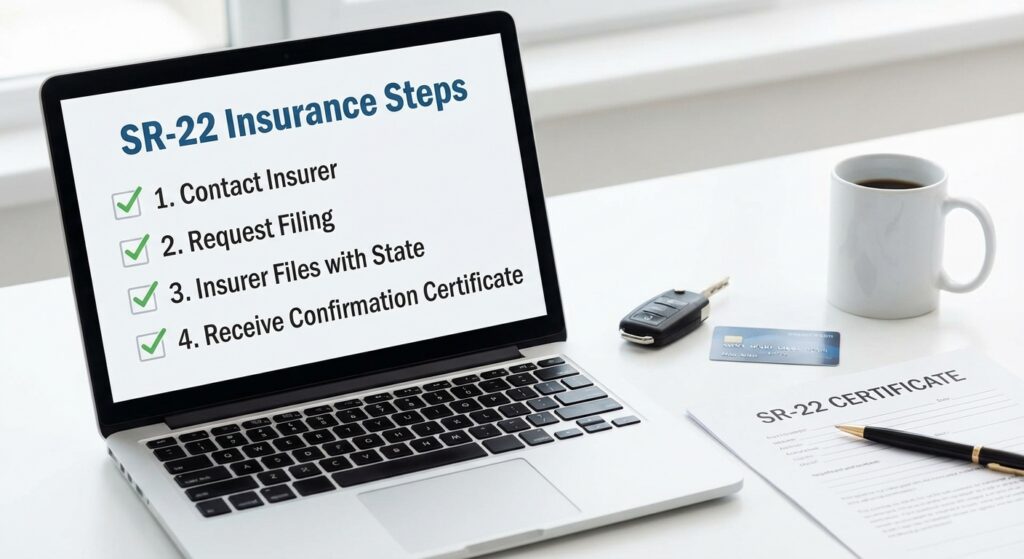
How you get an SR-22 depends on whether you already carry insurance, need to buy a new policy, or do not own a vehicle. The order you take these steps matters, because the state will not clear your license until a valid policy and SR-22 are in place.
If you already have auto insurance in place
Drivers who already have an active auto policy usually start by calling their current insurer. Some companies are willing to keep you as a customer and add the SR-22 filing, while others may decide to cancel or not renew the policy after a serious violation.
If your insurer does handle SR-22 filings, the typical steps look like this:
- Tell your agent or customer service rep you have been ordered to carry an SR-22.
- Confirm that your existing liability limits meet or exceed what your state requires.
- Agree to pay any filing fee the insurer charges for submitting the SR-22 form.
- Ask how and when they will submit the filing to your state agency.
- Follow up with the state if you do not receive confirmation of acceptance after the stated time frame.
Keep copies of all letters and emails that mention your SR-22, and save any confirmation number or proof of filing in case the state asks for it later.
If you do not currently have coverage
If your old policy was cancelled or you were driving without insurance, you will need to shop specifically for companies that accept high-risk drivers and offer SR-22 filings. Not all insurers write these policies in every state.
A simple way to approach this is:
- Collect your license number, violation dates, and any court or DMV paperwork.
- Contact several insurers or agents and ask directly whether they write SR-22 policies in your state.
- Compare quotes that include the SR-22 filing, not just a basic liability policy.
- Choose a policy that meets the state’s requirements and fits your budget as closely as possible.
- Confirm that the insurer will file the SR-22 immediately after you make your first payment.
Because high-risk policies cost more, it can be tempting to choose the absolute cheapest offer. It is just as important to ask about customer support and how they handle late payments or policy changes, because those details affect how easy it is to stay compliant.
When you need non-owner SR-22 coverage
Some drivers need an SR-22 to get their license back but do not own a car, truck, or motorcycle. In that case, a non-owner policy can sometimes meet the requirement while keeping costs lower than insuring a vehicle you do not have.
A non-owner SR-22 policy generally:
- Provides liability coverage for you while driving vehicles you do not own, with permission
- Does not cover vehicles titled or garaged in your name
- Does not include collision or comprehensive coverage for any vehicle
When you request quotes, be clear that you need non-owner coverage plus an SR-22 filing. If you later buy a car, your insurer can usually switch you from non-owner to owner coverage and keep the SR-22 attached.
Moving between states while under SR-22 requirements
Moving to a new state during an SR-22 period adds an extra layer of complexity. Your obligation comes from the state that ordered the SR-22, and moving does not erase that requirement.
In most cases, you must keep a policy that satisfies the rules of the state that imposed the SR-22 while also meeting the insurance laws in your new state. That often means working with an insurer licensed in both places and giving both motor vehicle agencies your new address.
Some insurers have invested in faster digital filing systems to make this easier. According to an EY Global Insurance Outlook 2025 analysis, carriers that partnered with DMV-integrated tech vendors cut average SR-22 filing times from about five days to under one hour, reduced lapse rates among high-risk policyholders by 6%, and improved customer satisfaction scores by 12% in the first year.
When you shop for coverage, asking how quickly and how electronically an insurer can file or transfer an SR-22 can save you days of waiting and lower the risk of a gap in your record.
SR-22 insurance costs explained for tight budgets
SR-22 filings increase your total insurance costs in two distinct ways: you pay a one-time filing fee, and you face higher ongoing premiums as a high-risk driver. The premium increase is usually the bigger issue over the long run.
According to an A Plus Insurance overview of SR-22 costs, SR-22 surcharges commonly raise premiums by about 20% to 50%, which often adds roughly $200 to $500 per year, and the average annual SR-22 premium in California for 2025 ranges from $1,800 to $3,000.
What drives SR-22 insurance pricing
Several factors combine to shape what you will actually pay for coverage with an SR-22 attached. The main drivers include:
- Violation type: A recent DUI usually raises rates more than a single at-fault crash or a lapse in coverage.
- State rules: Minimum liability limits and rating rules vary widely, which affects every quote you receive.
- Driving history: Older tickets and accidents still matter, especially if there are several on your record.
- Vehicle type: Powerful or expensive vehicles generally cost more to insure than modest sedans.
- Coverage choices: Higher liability limits, lower deductibles, and full coverage all increase your premium.
- Prior insurance gaps: A history of cancellations or lapses tells insurers you may be harder to keep insured.
Because the SR-22 is tied to an underlying policy, improving any of these cost drivers where you can will help reduce what you pay overall, even if the SR-22 itself still has to stay on file.
Sample SR-22 insurance cost scenarios
The following examples are simplified and for illustration only, but they show how SR-22 requirements can change what you pay each year. Your own numbers will depend on your state, record, and vehicle.
| Driver situation | Estimated base annual premium | Estimated SR-22-related increase | New estimated annual premium |
| First DUI, otherwise clean record, mid-priced sedan | $1,200 | $400 extra per year | $1,600 |
| Multiple speeding tickets, minor at-fault crash | $1,000 | $250 extra per year | $1,250 |
| No car, non-owner SR-22 policy | $600 | $150 extra per year | $750 |
When a DUI triggers both an SR-22 and a court-ordered ignition interlock requirement, you also need to budget for the device, installation, and calibration service. Working with a provider that offers clear, state-approved ignition interlock pricing and no hidden fees can make it easier to manage those costs alongside your SR-22 premiums.
Some drivers prefer companies that spread costs out with bi-weekly payments and low service fees, so the combined impact of SR-22 insurance and an interlock device does not overwhelm a tight monthly budget.
SR-22 timeline, compliance, and avoiding costly mistakes
Every state sets its own rules for how long you must keep an SR-22 on file, but many require a period of about three years for serious violations. The countdown usually starts from the date your license is reinstated, not the date of the original offense.
Typical SR-22 timeline from violation to removal
While details differ by state and offense, many drivers follow a similar overall path from violation to freedom from SR-22 requirements:
- A serious violation leads to a suspension or revocation of your license.
- Court or DMV paperwork tells you that proof of financial responsibility is required.
- You purchase a qualifying policy and have the insurer file an SR-22 with the state.
- Your license is reinstated or you receive a restricted or hardship license.
- You maintain continuous coverage with the SR-22 attached for the full required period.
- After the period ends, you verify with the state that the SR-22 requirement has been satisfied before changing or dropping coverage.
It is a mistake to assume the requirement ends automatically on a certain date. Always confirm directly with your motor vehicle agency or check your online driver record before removing the filing.
Avoiding SR-22 compliance mistakes that trigger suspensions
Once the SR-22 is in place, the most important job is keeping it there without any gaps. Compliance mistakes are common, and they often send drivers right back into suspension or revocation.
Missteps to watch for include:
- Letting your policy cancel for nonpayment, even briefly
- Switching insurers before the new SR-22 has been filed and accepted
- Ignoring mail or email from your insurer or the DMV about your status
- Failing to update your address after a move, so notices go to the wrong place
- Assuming you can drop coverage as soon as court obligations end, without checking DMV rules
Many insurers now use automated systems to reduce these problems. The Triple-I/Milliman 2025 U.S. P-C Insurance Outlook reports that insurers using automated proof-of-insurance APIs tied to state databases cut SR-22 compliance errors by 15% and kept 5% more high-risk customers year over year, while state penalty assessments on drivers in these programs dropped.
From a driver’s point of view, that means choosing an insurer with strong reminders and clear communication can make it much easier to stay on track. If you also have an ignition interlock requirement, missing device service appointments or ignoring calibration reminders can carry similar risks for your license.
Lowering SR-22 insurance cost over time as a high-risk driver
High-risk premiums do not have to stay high forever. As violations age and you build a safer record, insurers often become more willing to lower your rates or move you into a less expensive risk tier.
A 2024 Consumer Reports survey found that 60% of U.S. auto-insurance policyholders saw premium increases in the past year, which makes it even more important for SR-22 drivers to take every available step to control costs.
Building safer driving habits that show up in your record
The foundation of lowering SR-22 insurance costs is simple: avoid new tickets and accidents. Every clean month that goes by moves your last violation further into the past, which helps when your policy is renewed.
Concrete steps that help include obeying speed limits, leaving more space between you and the car ahead, and never driving after drinking or using impairing substances. Many states also allow approved defensive driving or driver improvement courses, which can sometimes reduce points or qualify you for small discounts.
If you rely on a restricted or hardship license, treat every drive as if you were being graded. A spotless record during your SR-22 period tells future insurers you have taken the situation seriously.
Using telematics and discounts to shrink SR-22 insurance rates
Some insurers now offer usage-based or telematics programs that track how, when, and how far you drive. For high-risk drivers who are willing to be monitored closely, these programs can offer a quicker path to lower premiums.
A Deloitte financial services industry prediction on predict-and-prevent risk management describes a regional carrier that added usage-based sensors to its SR-22 book, re-rating policies every 90 days to reward safer driving. Over 18 months, claim frequency for SR-22 drivers in the pilot dropped 12%, average premiums declined 8%, and the insurer’s combined ratio improved by four points.
Those results show how fast your behavior can start to matter again, even after a serious mistake. If you are comfortable with the privacy trade-offs, asking potential insurers about safe-driving telematics programs can be a smart move.
Planning your budget and shopping smart for coverage
Managing SR-22 insurance is easier when you have a clear budget and a plan. That means knowing exactly when payments are due, setting aside money for renewals, and avoiding last-minute scrambles that could lead to a lapse.
Practical tactics include:
- Setting up automatic payments or calendar reminders for every due date
- Reviewing your coverage once a year to see if higher deductibles make sense for your situation
- Driving a vehicle that is affordable to insure rather than one that is expensive to repair or replace
- Comparing quotes at renewal time instead of assuming your current insurer is still the best fit
For drivers dealing with both SR-22 insurance and a DUI-related ignition interlock, making device costs predictable is just as important. A provider such as Low Cost Interlock focuses on transparent pricing, single-use mouthpieces for hygiene, and a compact device nicknamed “The Can,” along with affordable $20 calibrations and no penalty fees for failed tests.
Features like fuel-cell sensors calibrated to state-specific BrAC limits, remote warm-ups through a mobile app, and bilingual support can make it easier to stay compliant on the ignition interlock side while you work on lowering your insurance rates.
Frequently Asked Questions
Does filing for an SR-22 affect my credit score?
The SR-22 itself does not appear on your credit report or directly affect your credit score. However, missed or late insurance payments that lead to collections can hurt your credit, so building a realistic payment plan is important.
What happens after my SR-22 period ends?
Once the state confirms your SR-22 requirement is complete, your insurer can remove the filing and re-rate your policy based on your current risk profile. You may then be able to shop more broadly for coverage and qualify for standard or preferred rates again over time.
Can an SR-22 requirement impact my job or future employment opportunities?
For jobs that involve driving company vehicles, an SR-22 and serious violations can limit your eligibility until your record improves. Some employers also run motor vehicle record checks for roles that require travel, so being transparent and showing a history of compliance can help.
Is SR-22 coverage available for drivers with a commercial driver’s license (CDL)?
Some insurers can attach an SR-22 to a personal auto policy for CDL holders, but commercial policies follow separate rules and may be harder to place after serious violations. Working with an agent who specializes in commercial and high-risk drivers can improve your options.
How is an SR-22 different from an SR-26?
An SR-22 is the certificate that proves you have active financial responsibility, while an SR-26 is the form your insurer files to notify the state that your SR-22 policy has been canceled or ended. An unexpected SR-26 filing during your required period can quickly lead to a new suspension.
Will an SR-22 requirement affect my other insurance policies, like homeowners or renters insurance?
Auto-related violations and an SR-22 requirement do not usually change your homeowners or renters premiums directly. However, some insurers look at your overall risk profile across products, so you might see fewer multi-policy discounts or be moved to different underwriting tiers.
How can I choose the best insurance company when I need an SR-22?
Look beyond the lowest quote and ask about their experience with high-risk drivers, how quickly they file SR-22 forms, and what support they provide if you move or need to change vehicles. Reading reviews from other drivers with SR-22s and confirming 24/7 service availability can also help you avoid future headaches.
Regain control of your license and life after SR-22 requirements
SR-22 insurance can feel like a heavy weight, but it is also a clear roadmap: get the right filing in place, keep coverage active, drive safely, and the requirement will eventually end. During that period, every on-time payment and uneventful trip moves you closer to normal rates and a full license.
If your SR-22 stems from a DUI, you may also be managing an ignition interlock requirement at the same time. Working with a partner that understands DUI compliance, offers the lowest cost ignition interlock device guaranteed, and provides no hidden fees or penalty charges can make that part of the process far less stressful.
Low Cost Interlock helps drivers meet court and DMV ignition interlock orders quickly with the LCI-777 device, state-approved fuel-cell technology, and convenient remote warm-ups from a mobile app. With flexible bi-weekly payments, discreet equipment, and reliable calibration reminders, it is designed to support the same goal as your SR-22 filing: staying compliant so you can get back to everyday life.
If you are ready to move forward, you can visit Low Cost Interlock’s website or call 844-218-5398 to schedule installation and coordinate your ignition interlock needs alongside your SR-22 insurance. Taking care of both pieces now helps you protect your driving record, satisfy the court, and regain control of your future behind the wheel.