

The Ultimate Ignition Interlock Installation Checklist
Your interlock installation appointment is on the calendar, and now
one question is rattling around your head: what do I actually need
to bring? Show up missing one piece of paperwork and you can lose
the time slot, push back your restricted license, and pay for a second
visit you didn’t budget for.
This checklist covers what to gather before your appointment, what
happens at the service center, and how to avoid the small mistakes that
cost most people their installation day. First-time or transferring from
another provider — same goal either way: one trip in, one device out, no
rescheduling.
The
Full Interlock Installation What-to-Bring Checklist
Most rescheduled appointments come down to a missing document or a
vehicle that isn’t ready. Here is the complete list of what to bring,
broken into four buckets. Print it or save it on your phone.
Required Documents
Vehicle Prep
Payment & Insurance
Logistics
That’s the short version. The rest of this article walks through each
bucket so you know why each item matters and what to do if
something is missing.
What to
Bring to Your Ignition Interlock Appointment

Technicians verify your identity and your legal authorization to
install the device before they touch your car. Miss a single item and
they will turn you away. State interlock program guides published by
groups like the American
Association of Motor Vehicle Administrators consistently recommend
pre-appointment checklists for exactly this reason — they cut down on
no-fault rescheduling, which costs you time and the provider a service
slot.
Identity and License
Paperwork
Bring a valid, non-expired government-issued photo ID. If your state
has already issued a restricted or hardship license, bring that too. A
handful of states ask for both the suspended license and the new
restricted permit, so check with your DMV the day before. If your name
on the court order differs from your ID — common after a marriage,
divorce, or legal name change — bring the certificate that proves the
link.
Court Orders and DMV Notices
Your court order or DMV compliance notice spells out the exact terms:
how long the device stays installed, what reporting interval applies,
and any state-specific settings the technician has to program. Without
it, the installer cannot verify the monitoring period. Bring the
original or a clear printed copy, not a phone photo of a faxed scan.
If a probation officer, treatment court, or separate monitoring
agency issued its own paperwork, bring that as well. These documents
sometimes override the original court order on things like reporting
cadence.
Vehicle Registration and
Insurance
The registration has to match the name on your court order. If it
doesn’t — because you drive a spouse’s car, a parent’s car, or a leased
vehicle — you’ll need a written authorization letter from the registered
owner. For leased and financed vehicles, contact the leasing or finance
company a few days ahead. They often have a specific form for interlock
approval, and getting it through their legal team can take 48 to 72
hours.
Proof of current auto insurance is standard everywhere. Lapsed
coverage stalls or cancels the appointment, full stop. SR-22 filing
isn’t a separate insurance policy — it’s a certificate your insurer
files with the state — but you may need to show the SR-22 confirmation
alongside your regular insurance card.
Payment Method
Have payment ready before you walk in. Most service centers take
credit and debit cards. Cash and personal checks vary by location. If
you’re worried about the bill, Low
Cost Interlock offers flexible billing options and a price match
guarantee — call ahead and confirm what the day-one total will be so
there are no surprises at the counter.
How to Prepare
Your Vehicle Before Installation
Documents are half the job. Your car has to be ready too. Most
install-day failures that aren’t paperwork problems are vehicle problems
— and they’re almost all preventable with a 10-minute check the day
before.
Battery, Electrical, and
Engine Health
A weak battery is the single most common vehicle reason an install
gets pushed. Interlock devices draw power from the car’s electrical
system, and a battery that’s dying will fail the install diagnostics.
Start your car the day before, let it run for a few minutes, and confirm
it starts cleanly. If you’ve been jumping it lately, get the battery
tested or replaced first.
If your check-engine light is on, look up the code or have a shop
scan it. A flashing check-engine light, in particular, points to a
misfire or emissions fault that can interfere with the install. Power
steering and electrical accessories should all work normally. The
technician needs a stable system to wire into.
Keys, Fobs, and Push-Button
Start
Bring every key that starts the car. If your vehicle has a
push-button start or a smart-key system, mention that when you book —
some of those setups need extra install time, and a few require a
specific install procedure. Newer hybrids and EVs can also need extra
time because the wiring path differs from a conventional gas vehicle.
Call the service center to confirm they install on your specific make
and model before you show up.
Confirm the Appointment
Details
Call or check your confirmation the day before. Verify the address,
the time, and the technician you’re scheduled with. Block off the full
morning or afternoon — installations usually run a couple of hours once
you add paperwork review and training, and rushing the end of an
appointment is how people miss things during the breath-test
walkthrough.
If a co-signer or the registered owner needs to be there, lock down
their schedule too. Showing up without a required party wastes the whole
slot. To find a service center in your area, use the LCI locations
finder.
What
Happens During an Interlock Installation Appointment
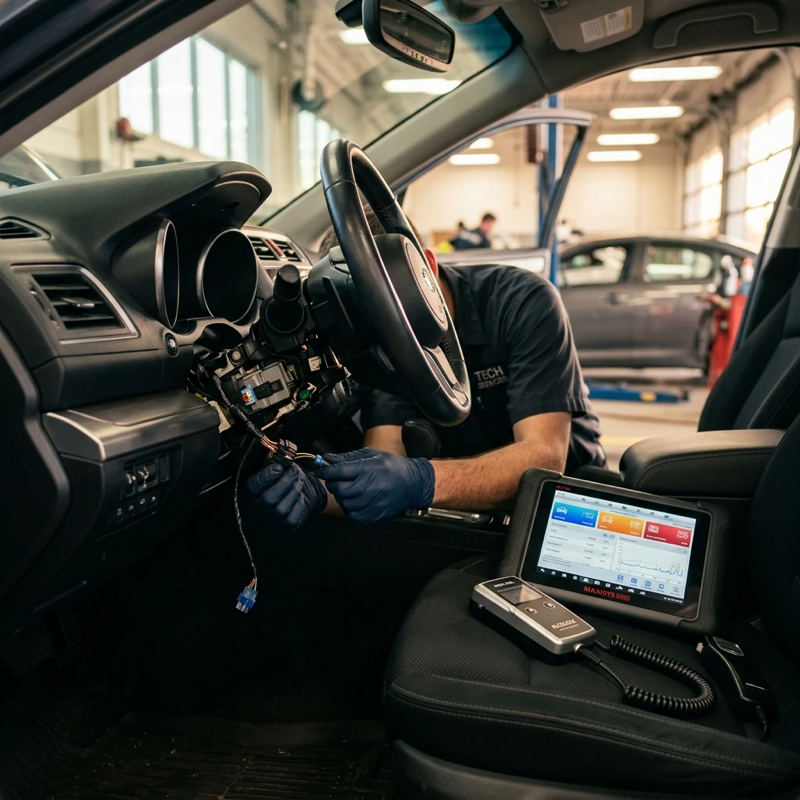
Knowing the rough flow of the appointment makes the day less
stressful. Here’s how a typical visit goes.
The technician starts with paperwork review: your ID, the court order
or DMV notice, the registration, and insurance. Intake usually takes 10
to 15 minutes. If anything is missing or any names don’t match, the
appointment stops here and you reschedule. This is the moment most
people get caught — which is exactly why the checklist exists.
Next is the physical install. The technician wires the device into
your vehicle’s ignition system and runs power from the battery. Time
varies a lot by vehicle: older cars with simple wiring go faster, newer
cars with complex CAN-bus systems and push-button start take longer.
After the hardware is in, you do the training. You’ll blow into the
Co-Pilot handset to learn the breath-test technique, run through the
startup sequence, and practice handling a rolling retest while the car
is parked.
Before you leave, the technician schedules your first calibration
service. Calibration intervals vary by state and offense — some states
run 30 days, others 60. Low Cost Interlock includes transparent pricing
with no hidden fees and sends SMS plus email reminders so the date never
sneaks up on you. You can also schedule your
install online if you haven’t booked yet.
Common
Reasons Interlock Installations Get Delayed
Almost every delay falls into one of five buckets. All five are
preventable.
- Mismatched names. The registration doesn’t match
the court order or the ID. Fix this with an owner authorization letter
or by updating the registration before your appointment. - Expired documents. An expired license or a lapsed
insurance policy stops the install on the spot. - A weak battery or electrical fault. The device
needs reliable, stable power. Get the battery tested if you’ve had any
starting issues. - Missing court paperwork. Without the order
specifying your interlock requirement, the technician cannot verify
compliance terms or program the right monitoring period. - No payment ready. Arriving without a working card
means no install that day.
If you’re not sure whether your specific situation is covered —
out-of-state DUI, business-titled vehicle, motorcycle, EV — clear that
up before the appointment. The state DUI laws
page covers state-specific install requirements, and the LCI FAQ page handles
the common edge cases.
What to Expect
After Your Interlock Is Installed
The first week is a learning curve. That’s normal. Every time you
start the car, the device prompts a breath test. While you drive, you’ll
get rolling retests at random intervals. When one hits, pull over
safely, blow the sample, and keep going.
First-Week Mistakes to Avoid
Mouthwash, certain foods, sugar-free gum, and hand sanitizer fumes
can all trigger a failed breath sample even though you haven’t had a
drink. The fix is simple: rinse your mouth with water and wait 15
minutes after eating or drinking anything before testing. A single
failed rolling retest doesn’t disable your car, but a pattern of
failures gets reported to your monitoring agency. The interlock
rolling retest guide covers exactly how the retest sequence
works.
Get the calibration date on your calendar the day of install. Missed
calibrations count as violations in most states whether you’ve driven
sober the entire month or not. And if your car needs service before your
next calibration, coordinate with your interlock provider first so the
shop doesn’t accidentally trigger a tampering alert when they disconnect
the battery.
Frequently Asked Questions
Can
I get an interlock installed if the vehicle is titled in a business
name?
Yes, in most cases. You will usually need a company authorization
letter signed by an officer of the business and, in some states, written
proof that you are permitted to operate the vehicle for work. Call the
service center and your monitoring authority ahead of time to confirm
the exact wording each one needs. Some states have a specific form;
others accept any signed letter on company letterhead.
What
should I do if my name changed and my documents do not match?
Bring legal proof of the change — a marriage certificate, divorce
decree, or court-issued name change order — and update your DMV records
as soon as you can. Ask the service center in advance whether they can
proceed with supporting documentation or if they need updated ID first.
Policies vary, and getting clarity on the call beats arriving and
finding out they cannot work with the name mismatch.
Can
I install an interlock on a motorcycle, leased vehicle, hybrid, or
EV?
Most service centers install on cars, trucks, SUVs, hybrids, and EVs
without an issue. Motorcycles are a different story — some states do not
require interlocks on bikes, and not every provider installs on them.
Leased and financed vehicles need a written authorization letter from
the lender or leasing company. Call before booking and confirm the
specific vehicle, year, and trim are supported at the location you
picked.
Can I
choose where the interlock handset is mounted?
Placement options vary by vehicle, but installers can often
accommodate reasonable preferences as long as the device stays
accessible, safe, and compliant with state guidelines. The handset has
to be reachable while you are in the driver’s seat, and the cable has to
route cleanly. If discretion matters to you, ask about the Interlock Can
option, which is designed to look like a soda can in your cup
holder.
Are
there restrictions on who can drive my car once the interlock is
installed?
Often, yes. Anyone who drives must be able to complete the breath
tests, and any violations recorded on the device may be attributed to
you as the registered user. If other people in the household drive the
car, ask your provider and monitoring authority about the rules in your
state. Some states allow shared driving; others require a specific
exemption or workaround.
What
happens if I fail a test because of a medical condition or prescription
medication?
Interlock devices measure alcohol, not prescription medications. That
said, some medical conditions make providing a clean breath sample
harder, and a small number of medications and mouthwashes contain
alcohol that can register. Contact your provider before installation to
ask about approved accommodations and documentation. The foods
and items that can trigger a BrAC reading guide is also worth
reading before your first week.
How do
I avoid accidental tampering flags in normal use?
Do not unplug, remove, or attempt to bypass any part of the system.
Avoid unsupervised jump-starts and battery swaps. If your car needs
electrical work, towing, or a battery replacement, call your provider
first so the visit gets documented properly and the diagnostic data is
logged correctly. Most tampering alerts that get people in trouble are
accidental, and a single phone call prevents almost all of them.
Can I
transfer my interlock to a different vehicle later?
Usually, yes. Transfers are scheduled service events that require
updated vehicle paperwork and, in most states, approval from your
monitoring authority. Contact your provider before changing vehicles so
you stay compliant and do not create a gap in required monitoring.
Trying to move the device yourself counts as tampering and will be
flagged.
What
if I lose my court order or cannot find my paperwork?
Call your attorney, the court clerk, or your probation officer and
request a certified copy. Many courts can email a copy the same day or
mail one within a few business days. Do not show up to the install
without it — the technician cannot program your monitoring period
without seeing the order.
How long
does an interlock installation actually take?
Most installs run between an hour and a few hours, depending on the
vehicle, the technology in the car, and how long the paperwork review
takes. Push-button start systems, newer hybrids, and EVs can add time.
Block out the full morning or afternoon and you will not feel rushed
during the training portion, which is the part you actually need to
absorb.
Installation Day Game Plan
Walk in prepared and the whole installation is straightforward. Save
this checklist on your phone: valid ID, court order, vehicle
registration, current insurance, SR-22 if your state requires it, owner
authorization for a vehicle not titled in your name, all keys and fobs,
and a working payment method. Test-start your car the night before.
Block enough time. Confirm the appointment.
Need to book or have a question about your specific situation? Call
Low Cost Interlock at (844) 387-0326 for a 60-second
quote, or schedule your
installation online. Drop-off vehicle service is available at many
locations if you need to leave the car for a few hours, and the team can
walk you through exactly what to bring for your state.