
GPS Tracking in Ignition Interlock Devices Explained
GPS tracking in ignition interlock devices is changing how DUI monitoring works, and it can raise a lot of questions the first time you hear about it. You might be worried about feeling “tracked,” confused about what your court order actually requires, or unsure how GPS affects the cost and complexity of your program.
Understanding how this technology fits into a modern ignition interlock program helps you stay calm, avoid violations, and complete your requirements on time. This guide breaks down why some interlocks include GPS, how the technology operates, what data is and is not collected, how privacy and legal rules apply, and how to use a GPS-enabled device to protect yourself rather than feel powerless.
Why GPS Features Are Showing Up in More Ignition Interlock Devices
An ignition interlock device (IID) has one basic job: stop a vehicle from starting if the driver’s breath alcohol concentration is over a preset limit. Traditionally, IIDs recorded breath test results, lockouts, and tamper events, but they did not track where you were driving. Many courts are now layering GPS location onto that existing data to tighten DUI supervision.
Ignition interlocks in DUI sentencing today
More DUI cases now include ignition interlock requirements as a standard condition of getting a restricted or hardship license. According to a 2023 National Conference of State Legislatures traffic safety review, 34 U.S. states plus the District of Columbia now require ignition-interlock devices for all DUI offenders.
When many states rely on IIDs, courts and legislatures naturally start asking how to make those programs harder to cheat and easier to monitor at scale. GPS modules, on-board cameras, and cellular reporting are all tools being added to solve enforcement problems that older, stand‑alone interlocks could not address well.
Why some courts now insist on GPS, cameras, and real-time alerts
Courts have reported people trying to get around interlock rules by using remote starters, unplugging the device between trips, or letting someone else blow to start the car. Without location or photo evidence, it can be hard for probation officers to prove when the actual offender was behind the wheel or whether travel limits were respected.
A 2024 enhancement statute summarized in a DUI News Blog analysis shows how some states are responding. That law requires every court-ordered IID to include embedded GPS, an on‑board camera, cellular telemetry, and real-time tamper alerts, with location logs and breath-test results pushed automatically to probation dashboards. In its first six months, confirmed tamper events dropped 31% and “missed-test” violations fell 27%, but public-defender groups challenged the added 24‑hour location logging as an intrusive search and noted an average extra cost of $28 per month for low-income drivers.
For you as a driver, the key takeaway is that GPS and real-time reporting are usually added to address specific enforcement issues, not to punish you for every mile you drive. Your paperwork should spell out whether GPS is mandatory in your case or simply part of an optional device model.
How GPS Tracking in Ignition Interlock Devices Works Day-to-Day
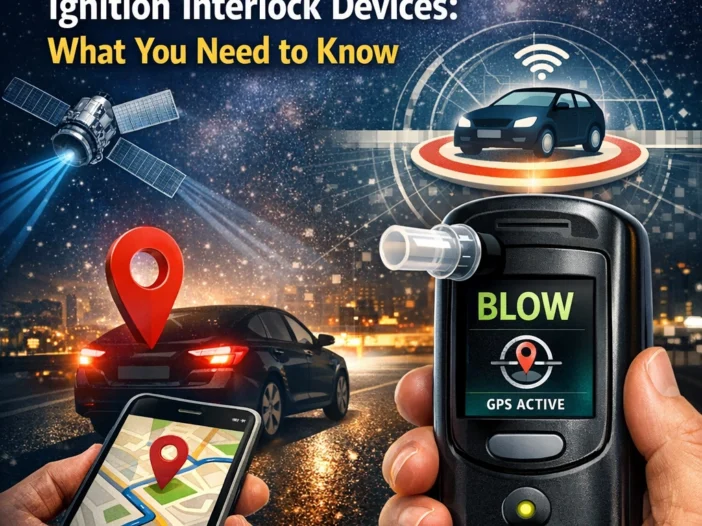
At a technical level, GPS-enabled interlocks add a location chip and a cellular modem to the familiar handheld unit and under-dash wiring harness. The GPS component calculates your position from satellite signals, while the modem securely sends that information, along with breath-test data, back to a monitoring server.
Most systems are event-based rather than constant live trackers. That means location is captured and transmitted when specific things happen, such as a breath test, a failed test, a power loss, or a suspected tamper event. In some programs, there may also be scheduled “heartbeat” pings to show the unit is installed and functioning.
How GPS tracking in ignition interlock devices captures and sends data

While the exact setup varies by provider and state, the overall workflow is usually similar.
- Installation and activation. A technician installs the IID and GPS hardware, links it to your vehicle identification number, and activates it under your court or DMV case number.
- Finding your location. When the device is powered, its GPS receiver reads signals from multiple satellites to determine approximate latitude, longitude, and time.
- Capturing an “event.” Events include breath tests, engine starts, rolling retests, failed tests, lockouts, disconnections, and service visits. When one of these events occurs, the device logs it with a timestamp.
- Attaching GPS data. For configured events, the system tags the log with GPS coordinates. If the device has a camera, it may also capture a still image to confirm who is blowing.
- Transmitting to the server. Using a built-in cellular modem, the unit periodically uploads stored logs to a secure server run by the interlock provider.
- Review by monitoring agencies. Probation, the court, or a state DMV portal can then view reports showing breath-test results, violation codes, and location information relevant to your case.
In some programs, your officer may only dig into the GPS history if there is a violation or complaint, while in others they review all data on a schedule. Your supervision terms control how closely those logs are watched.
What your interlock system records – and what it doesn’t
Because privacy worries are real, it helps to separate myths from how these systems are actually designed. Details depend on your state and provider, but certain patterns are common.
Data typically recorded includes:
- Time and result of each required breath test, including starts and rolling retests.
- GPS coordinates at configured events, such as tests, violations, and service appointments.
- Device status codes, including power loss, disconnection, and suspected tampering.
- Lockout status if the device prevents the car from starting after repeated failed tests.
- Driver images for camera-equipped units, tied to specific breath events.
Data generally not recorded includes:
- In‑car audio, conversations, or anything you say while driving.
- Phone calls, text messages, or app usage on your mobile devices.
- Full driving behavior analytics like harsh braking or speeding, unless your program explicitly adds separate telematics hardware.
- Passenger identities, apart from what might be incidentally visible in a still photo.
Your contract and court order should describe the data set for your specific device. If something is not listed as being collected, it is usually outside the scope of what the interlock will monitor.
To see how a GPS-enabled IID compares with a basic one, it helps to line up the features side by side.
| Feature | Standard IID (no GPS) | IID with GPS | IID with GPS + camera |
| Location logging | None; only breath-test and device data are stored. | Location attached to selected events, such as tests and violations. | Location plus visual confirmation of who is blowing at key events. |
| Tamper investigation | Limited to codes showing disconnections or power loss. | Shows where suspected tampering occurred and whether the car was moved. | Adds images that can show who interacted with the device during tamper events. |
| Monitoring detail | Focus on pass/fail history and lockouts. | Allows officers to see travel patterns related to restrictions or curfews. | Provides the highest level of accountability for drivers considered high risk. |
| Typical use | Standard first-offense cases in jurisdictions that do not require GPS. | Cases with travel-zone rules, prior tampering, or higher supervision needs. | Repeat offenders or programs that always pair GPS with photo verification. |
| Relative cost | Baseline monthly monitoring fee. | Usually somewhat higher due to added hardware and data service. | Often the highest due to combined GPS, camera, and data requirements. |
Many drivers find it less stressful when a provider clearly explains which device model they will receive and how GPS monitoring works. Low Cost Interlock focuses on simple explanations about whether GPS or camera features apply in your state and how they affect your reporting schedule.
Privacy, Costs, and Legal Safeguards Around Interlock GPS
The idea of your car reporting its location can feel like too much, especially when you are already dealing with court, fines, and license worries. The good news is that privacy law, consumer expectations, and federal regulators are all pushing interlock providers toward tighter controls on how location data is collected and used.
Understanding who can see your information, how long it is kept, and what protections exist can help you ask better questions and choose a program that respects your boundaries while still keeping you compliant.

Who can see your interlock GPS location data
A 2025 Deloitte Insights connectivity and mobile trends survey found that 72% of U.S. consumers are concerned about how companies use and share their location data. Those concerns absolutely apply when GPS is tied to a court order.
With an IID, access is typically limited to three groups: the device provider that runs the servers, the agency responsible for monitoring your case (often probation or the DMV), and, when necessary, courts or attorneys who obtain records through official channels. Within those organizations, only specific staff are authorized to review detailed logs tied to your case number.
Lawmakers are also reshaping the rules. By the end of 2025, 16 U.S. states will have comprehensive consumer-privacy laws in effect, and many of those statutes classify precise geolocation as sensitive data, according to the International Association of Privacy Professionals state privacy legislation tracker. That sensitive-data label generally means stricter limits on collection, shorter default retention windows, and clearer disclosures about how information is shared.
In practice, your interlock GPS data is often retained at least for the length of your supervision period, and sometimes for additional years if required by state audit rules. Your provider should be able to explain its retention schedule in plain language before you sign anything.
Regulators are tightening rules on in-car location tracking
Federal regulators have started paying close attention to how connected cars and monitoring devices handle location data. A May 2024 Federal Trade Commission Tech at FTC blog on cars and consumer data warned that quietly collecting and sharing in‑car geolocation information could be treated as an unfair or deceptive practice under Section 5 of the FTC Act. The guidance specifically pointed to court-mandated driver-monitoring hardware and emphasized best practices such as data minimization, encrypted storage, time-limited retention, and full disclosure of every third party that receives location data, with potential penalties of up to $50,120 per violation.
Industry groups are responding. A March 2024 Future of Privacy Forum vehicle safety systems report outlines a privacy-by-design checklist recommending that GPS data from safety systems like ignition interlocks stay encrypted in transit and be deleted when the underlying court order ends. Two major IID suppliers cited in that report adopted the checklist and saw about a 40% reduction in the raw location points they stored on cloud servers.
For drivers, these developments mean you should expect clear answers about what an interlock vendor collects, how it is protected, and when it will be erased. If a provider cannot explain their practices or seems vague about data sharing, that is a sign to be cautious.
GPS and cellular monitoring can add to the cost of your program compared with a basic IID, because you are paying for extra hardware and data transmission. If cost is a big concern, look for transparent ignition interlock pricing with no hidden fees so you know exactly what GPS-related charges will look like over the life of your requirement.
If you are still unsure whether your specific court order requires GPS, or how location data will be handled in your state, our support team can walk through your paperwork line by line and explain your options before you commit to an installation.
Frequently Asked Questions
Can GPS data from my ignition interlock be used against me in a new criminal case?
In many jurisdictions, location records from a court-ordered device can be subpoenaed as evidence if prosecutors believe they are relevant. However, a judge typically decides whether and how that data can be used, and your attorney can challenge overly broad requests or raise constitutional objections based on local law.
How does a GPS-enabled ignition interlock affect my car insurance rates?
Insurance companies generally base rates on your DUI conviction, not specifically on whether your interlock has GPS. That said, demonstrating consistent compliance and avoiding violations during your interlock period can sometimes help when you later shop for a new policy or request a review of high-risk premiums.
What happens if someone else needs to drive my car that has a GPS interlock installed?
Anyone driving your vehicle must use the device exactly as instructed, and all activity will still be logged under your case. It’s wise to document who is allowed to drive, explain the rules in writing, and clear any regular secondary drivers with your attorney or supervising officer so their use doesn’t create confusion in your records.
How can I dispute GPS data if I believe the location or time is wrong?
If you notice a discrepancy, request a copy of your logs, document where you actually were (receipts, time-stamped messages, witnesses), and raise the issue in writing with both your provider and supervising agency. In contested cases, your attorney can ask the court to review device calibration records, cell coverage maps, or expert testimony on GPS accuracy.
What should I do if I move to another state while using a GPS-enabled interlock?
Before moving, contact your monitoring agency and interlock provider to confirm whether your current device is approved in the new state and how reporting will transfer. You may need to switch providers or have your case re-registered so that your new DMV recognizes your ongoing compliance and allows you to maintain or reinstate your license.
Are there extra steps for installing a GPS interlock on a leased or financed vehicle?
Most lease and finance agreements allow legally required safety equipment, but you should still review your contract and notify the leasing company if needed. Choosing a certified installer who uses non-destructive wiring methods and provides removal documentation can help you avoid disputes about vehicle condition at the end of the lease.
What should I expect when the GPS ignition interlock is finally removed?
Once you’ve met all program requirements and received written authorization, the provider will schedule a removal appointment and generate a completion report for your monitoring agency. Keep copies of all final paperwork, because you may need them later to clear DMV records, update your insurance, or verify that the device obligation has officially ended.
Using GPS-Enabled Interlocks to Stay Compliant and Get Back on the Road
Once you understand how GPS-enabled interlocks work, they become less of a mystery and more of a tool you can use to prove you are doing the right thing. Location and device data can cut both ways, but when you plan ahead, it often becomes a shield that protects you from misunderstandings instead of a spotlight that only catches mistakes.
Real-world ways GPS data is used in DUI cases
GPS data is most useful when there is a question about what actually happened on a certain day. In many cases, it ends up helping drivers show that they followed the rules rather than hurting them.
- Confirming you were at work or a scheduled appointment during a rolling retest window when a test was missed.
- Showing that you stayed within approved travel zones and did not drive to prohibited locations while on restricted routes.
- Clarifying that a power loss or device issue happened while the car was parked at a repair shop, not while you were trying to bypass the unit.
- Documenting that, after an early violation, your later breath tests remained clean and your driving patterns stayed consistent with your approved routine.
- Helping your attorney or probation officer quickly resolve disputes about whether someone else drove your car during a particular incident.
Used thoughtfully, GPS interlock data can speed up decisions, reduce the risk of false accusations, and show a clear record of improvement over time.
Choosing a provider and program that fits your situation
The right ignition interlock provider makes a big difference in how stressful your GPS monitoring experience feels day to day. When you compare programs, it helps to ask a consistent set of questions so you are not surprised later.
Key topics to cover include:
- Whether your specific court order or state law requires GPS, a camera, or both.
- Which events generate location logs and how often the system sends data.
- Who reviews your reports, how often, and what triggers a violation notice.
- How long data is stored and what happens to it after you complete your requirement.
- The full cost of installation, monthly monitoring, calibration, and any GPS-related fees.
- What customer support looks like if you have technical problems or questions about reports.
Low Cost Interlock is a state-approved ignition interlock provider focused on making these details simple, affordable, and predictable. Our flagship LCI-777 device uses a fuel-cell sensor calibrated to your state’s BrAC limit, with the option to meet GPS and camera requirements where they apply, and our single-use mouthpieces and compact “Can” design help keep the system discreet and hygienic.
To keep expenses manageable, we emphasize no hidden fees, no penalty charges for failed tests, $20 calibration appointments, and flexible bi-weekly payments. Our team can also review your paperwork to confirm whether a GPS-enabled device is required and match you with the most cost-effective setup that still keeps your license road-legal.
If you are ready to move forward or just need clearer answers about your obligations, you can reach Low Cost Interlock at 844-218-5398 or visit Low Cost Interlock online for state-specific ignition interlock information and scheduling.
Understanding how GPS tracking in ignition interlock devices works, what it records, and how providers handle that data turns a confusing requirement into a structured plan for getting your driving privileges back. When you choose a transparent, customer-focused program and stay on top of your obligations, GPS becomes one more way to document your progress and move past a DUI with confidence.